AC Repair Signs This Summer in Santa Monica, CA
Warning Signs Your AC Needs Repair This Summer in Santa Monica, CA
Santa Monica homeowners should watch for these AC repair signs this summer: warm air from vents, unusual grinding or rattling noises, short cycling, ice on refrigerant lines, and skyrocketing energy bills. Coastal salt air accelerates system corrosion up to 10 times faster than inland, making early diagnosis critical before a brief heat event turns a minor fix into an emergency call. How much AC repair costs in Santa Monica, CA, depends on the issue, but acting early almost always costs less.
Why Summer 2025 Is a Critical Year for Santa Monica AC Systems
Santa Monica sits in a meteorological paradox that most HVAC content ignores entirely. The city averages a mild year-round temperature range of 49°F to 76°F, rarely exceeding 84°F, and sees roughly one day per year when the thermometer climbs to 90°F or above. That statistical comfort, however, creates a dangerous false sense of security for homeowners.
Because Santa Monica’s climate is so temperate most of the year, air conditioning systems rarely get the sustained workout that stress-tests their components. Then September arrives, the marine layer retreats, and Santa Ana winds push desert heat into beach neighborhoods. Suddenly, an AC unit that seemed fine during June Gloom is asked to perform at full capacity for the first time in months, and whatever was quietly failing inside it announces itself all at once.
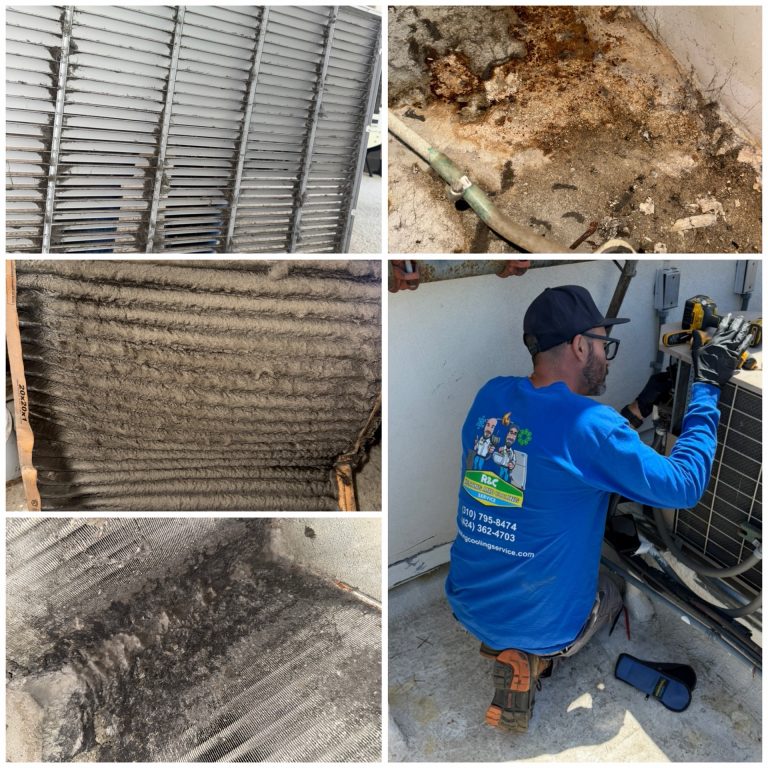
Layer onto that the aftermath of the 2025 Los Angeles wildfires. Hazardous PM2.5 smoke spread far beyond burn zones, and ash-clogged air filters, coils, and ductwork are quietly degrading system efficiency and indoor air quality across the greater LA basin, including Santa Monica. If your system has not had a post-fire inspection, this summer is the moment to schedule one.
What Are the Signs That My AC System Needs Repair?
Recognizing the difference between normal summer wear and a system screaming for professional attention is the most valuable skill a Santa Monica homeowner can develop. These are the warning signs that matter most in a coastal environment.
Warm or Lukewarm Air from the Vents
If your thermostat is set to cool and the air coming from your registers is room temperature or warmer, the system has a problem. The most common culprits are a low refrigerant charge caused by a leak, a failing compressor, or a frozen evaporator coil. In Santa Monica’s salt-air environment, refrigerant leaks often trace back to corrosion in the coil itself. Beach-adjacent homes in Ocean Park, the Wilshire-Montana corridor, and north of Montana Avenue face accelerated coil degradation that inland Los Angeles homeowners simply do not deal with at the same rate.
Unusual Noises: Grinding, Rattling, or Squealing
A properly functioning central AC system is a background hum. Grinding noises typically indicate metal-on-metal contact inside the compressor or blower motor bearings that have worn through their lubrication. Rattling often points to a loose component, a failing capacitor, or debris in the condenser unit. Squealing suggests a belt or motor bearing issue. None of these sounds resolve on their own, and all of them worsen rapidly under the sudden load of a Santa Ana heat event.
Short Cycling: The AC Turns On and Off Repeatedly
Short cycling means your system starts, runs for only a minute or two, shuts off, and then restarts almost immediately. This pattern is hard on every component in the system and dramatically increases energy consumption. Short cycling can stem from an oversized unit, a refrigerant leak, a dirty evaporator coil, or electrical issues with the capacitor or contactor. Left unaddressed, it accelerates wear that converts a $300 capacitor replacement into a $2,000 compressor repair.
Ice Forming on Refrigerant Lines or the Indoor Coil
Ice on your AC lines sounds counterintuitive, but it signals a serious problem. Restricted airflow from a clogged filter, a dirty coil, or a refrigerant charge that has dropped below proper levels can cause the evaporator coil to drop below freezing. Ice buildup then further blocks airflow, creating a feedback loop that can damage the compressor if not caught quickly. After a wildfire season that pushed ash into outdoor condenser units across the Los Angeles basin, this is a particularly relevant warning sign for 2025.
Sudden Spike in Your Energy Bill
If your electricity costs jump noticeably from one billing cycle to the next without a corresponding change in usage habits, your AC system is likely working harder than it should to maintain temperature. A dirty condenser coil, low refrigerant, a failing motor, or a duct leak all force the compressor to run longer, consuming more power. Given that 72 percent of homes in Santa Monica carry a Major Heat Factor rating and the city is projected to see a 200 percent increase in days over 82°F over the next 30 years, an inefficient system will only become more expensive to run.
Salt-Air Corrosion: Santa Monica’s Hidden AC Killer
This is the warning sign that separates coastal HVAC maintenance from everything else. Salt-laden ocean humidity corrodes condenser and evaporator coils up to 10 times faster than inland conditions. The result is pinhole leaks in the coil, refrigerant loss, and eventual coil failure. Visually, corroded coils often look like blue-green oxidation around the coil fins or refrigerant lines. If your outdoor condenser sits on the west-facing side of your property with relatively unobstructed ocean exposure, annual coil inspections are not optional; they are protective maintenance for a system operating in a genuinely hostile environment.
How Do I Know If My AC Needs Repair or Replacement?
The repair-or-replace question looks very different in Santa Monica than it does in the national HVAC conversation. With the average Santa Monica home value sitting at approximately $1,697,753, a properly functioning HVAC system is not just a comfort amenity; it is a component of a very significant real estate asset. The calculus of spending $800 on a borderline repair versus investing in a new system has a different answer here than it does in a market where homes trade at a third of that value.
The general industry guidance from ENERGY STAR (U.S. Environmental Protection Agency) is that if your heating and cooling equipment is more than 10 years old and showing signs of system failure, replacement deserves serious consideration. Depending on location, replacing an aging system with an ENERGY STAR-certified unit can save nearly $140 annually in energy costs.
A useful local framework is the 5,000 rule: multiply the system’s age in years by the repair estimate in dollars. If the result exceeds $5,000, replacement is typically the smarter financial decision. A 14-year-old system facing a $450 capacitor repair scores 6,300, which edges toward replacement territory, especially when California’s current energy efficiency requirements enter the picture.
Any replacement in Santa Monica must now comply with California’s 2025 Building Standards Code, which requires new residential HVAC installations to meet a minimum SEER2 rating of 15.2 for central systems. Upgrading from an older 10- to 12-SEER unit to a compliant 15.2 SEER2 or higher heat pump typically reduces cooling energy consumption by 15 to 30 percent. Replacement also requires a permit and HERS testing through the City of Santa Monica Building and Safety Division. Minor mechanical work, however, often qualifies for same-day single-trade permit review at the public counter.
One local financial incentive worth knowing: LADWP offers rebates of up to $2,500 per ton on qualifying heat pump HVAC systems. That rebate can meaningfully offset the cost of a code-compliant replacement and is worth factoring into any repair-versus-replace conversation with your technician.
AC Repair Cost Ranges for Santa Monica Homeowners
Local labor rates in Los Angeles run 20 to 30 percent higher than national averages, a reflection of California’s cost of living, prevailing wage environment, and peak-season demand. According to Angi’s Los Angeles HVAC cost data, contractors in the LA area charge between $100 and $150 per hour, with dispatch fees running $80 to $300, and emergency labor rates climbing to $150 to $500 per hour during high-demand periods.
| Repair Type | National Average Range | Santa Monica / LA Estimated Range |
|---|---|---|
| Service call / diagnostic fee | $100 to $250 | $150 to $300 |
| Capacitor or contactor replacement | $150 to $450 | $200 to $550 |
| Refrigerant recharge | $100 to $500 | $150 to $600 |
| Refrigerant leak repair | $250 to $1,500 | $350 to $1,800 |
| Fan motor replacement (condenser) | $200 to $500 | $280 to $650 |
| Blower fan motor replacement | $400 to $700 | $500 to $900 |
| Evaporator or condenser coil replacement | $600 to $2,400 | $800 to $2,800 |
| Full central AC system replacement | $3,900 to $7,900 | $5,000 to $12,000+ |
These ranges reflect the reality that the overall average AC repair lands around $350 to $400 nationally, but Santa Monica homeowners should budget for the higher end of any range given local labor market conditions and the added complexity of coastal corrosion repairs.
How Often Should I Have My AC Serviced in Santa Monica?
For most of California, annual maintenance is the standard recommendation. In Santa Monica, the honest answer is twice per year for any home within a mile of the ocean. The salt air corrosion dynamic is aggressive enough that a spring tune-up before summer heat events and a fall inspection after the Santa Ana wind season both earn their cost. A maintenance visit typically includes coil cleaning, refrigerant level check, capacitor and contactor inspection, drain line flush, and filter replacement, all tasks that directly address the failure modes most common in coastal systems.
Neighborhood Notes: Where AC Systems Take the Most Abuse
Not all Santa Monica AC systems age at the same rate. Properties in Ocean Park and the streets closest to the beach face the highest salt-air exposure and tend to see coil corrosion and refrigerant leaks earlier in a system’s lifecycle. Homes in the Wilshire-Montana district and north of Montana Avenue sit slightly further from the immediate coast but still experience meaningful marine influence. Multi-unit buildings near the Third Street Promenade area often have rooftop package units that face both salt air and urban heat island effects, making regular inspection especially important. Inland edges of the city, bordering Santa Monica Canyon or near the 10 freeway, experience conditions closer to standard Los Angeles norms, though coastal influence still exceeds what a strictly inland system would encounter.
Frequently Asked Questions
Why is my AC running but not cooling my house?
The most common reasons are low refrigerant from a leak, a frozen evaporator coil blocking airflow, or a failing compressor. In Santa Monica’s coastal environment, coil corrosion from salt air is a frequent root cause of refrigerant loss. A professional diagnostic visit is the fastest way to identify the specific issue and get an accurate repair estimate before the problem worsens.
What does it mean when my AC is blowing warm air?
Warm air from a running AC usually points to one of three problems: the refrigerant charge is low due to a leak, the compressor is failing and not properly pressurizing the refrigerant cycle, or the condenser coil is too dirty or corroded to release heat effectively. All three require a licensed HVAC technician to diagnose and repair safely and legally in California.
Why is my air conditioner short-cycling, turning on and off frequently?
Short cycling typically signals a refrigerant leak, an oversized unit, a failing capacitor, or an overheating compressor shutting itself down as a protective measure. It dramatically increases wear on the entire system and energy costs simultaneously. Catching short cycling early, before it damages the compressor, is the difference between a few-hundred-dollar repair and a multi-thousand-dollar replacement.
Is it worth repairing an AC unit that is 10 to 15 years old?
It depends on the repair cost relative to the system’s age and condition. A system over 10 years old facing a repair exceeding $800 to $1,000 is generally a replacement candidate, especially given California’s current SEER2 efficiency minimums. At Santa Monica’s median home values, a new code-compliant system also represents a genuine property maintenance investment, not just a utility upgrade.
What causes ice to form on AC refrigerant lines?
Ice on refrigerant lines indicates that the evaporator coil is dropping below freezing, which happens when airflow is severely restricted by a dirty filter or coil, or when the refrigerant charge is low. The ice itself then makes the airflow problem worse. Turn the system off and contact a technician promptly. Running a frozen system risks compressor damage, which is among the most expensive AC repairs possible.
How much does AC repair cost in Los Angeles compared to national averages?
LA-area HVAC contractors charge between $100 and $150 per hour for labor, plus dispatch fees of $80 to $300, running 20 to 30 percent above national averages. Emergency calls during summer heat events push labor rates to $150 to $500 per hour. Most standard Santa Monica repairs fall between $200 and $1,800 depending on the component, with full replacements ranging from $5,000 to $12,000 or more.
Summer in Santa Monica is short, sudden, and unforgiving to any AC system that has been quietly failing through the marine-layer months. The warning signs covered here are your early window to act before a $300 capacitor job becomes a $3,000 compressor emergency. R&C Heating and Cooling Service specializes in Santa Monica’s unique coastal HVAC conditions, from salt-air coil inspections to post-wildfire system cleanings, and serves homeowners across Santa Monica and the surrounding westside communities. Do not wait for the first real heat event to find out what your system cannot handle. Contact us today to schedule a pre-summer diagnostic before the calendar and the Santa Ana winds make the decision for you. You can also find us and read verified reviews at our R&C Heating and Cooling Service Google Business Profile, or get directions directly through R&C Heating and Cooling Service on Google Maps.